Discover the modern world of Aluminum Castings and their diverse industrial applications
Wiki Article
A Deep Study the Different Sorts Of Metal Casting and Their Utilizes
Metal Casting encompasses different strategies, each customized for specific applications and requirements. From the affordable sand spreading technique to the accuracy of investment casting, each procedure has special benefits. Pass away casting stands out in high-volume production scenarios, while lost foam spreading introduces innovative design possibilities. Furthermore, irreversible mold casting is identified for its resilience. Understanding these methods opens a home window into their sensible usages and ramifications in different industries. What exists under the surface area of these casting techniques?Sand Spreading: A Affordable and versatile Method
Various casting approaches exist, sand casting remains one of the most versatile and cost-effective methods in the metalworking industry. This technique utilizes a combination of sand and a binding agent to produce molds, allowing for the production of components in varied dimensions and forms. Sand casting is particularly useful for little to tool production runs, as it calls for minimal upfront financial investment in tooling compared to other spreading techniques.The process begins with the production of a mold, where liquified steel is poured in to form the preferred things when cooled down. Its adaptability allows the use of different steels, consisting of iron, light weight aluminum, and steel. Furthermore, sand spreading can suit complex geometries, making it appropriate for a variety of applications, from auto components to detailed artistic pieces. In general, sand casting's performance and adaptability strengthen its value in the production landscape.
Investment Casting: Precision and Information for Complex Shapes
Investment spreading stands out as a technique renowned for its capacity to produce highly outlined and detailed parts. This process entails developing a wax pattern that is covered with a ceramic covering, which is after that warmed to get rid of the wax and set the covering. The outcome is a specific mold and mildew that can capture complicated geometric forms with amazing precision.This spreading technique is particularly beneficial for generating get rid of thin wall surfaces, great functions, and tight resistances, making it ideal for industries such as aerospace, automotive, and medical tools. Investment spreading fits a range of steels, consisting of stainless steel, light weight aluminum, and titanium, making it possible for producers to meet details material demands.
Additionally, the procedure lessens machining needs post-casting, which can improve effectiveness and decrease manufacturing prices. In general, investment spreading is a favored choice for applications where precision and information are extremely important.
Die Spreading: High-Volume Manufacturing With Excellent Surface Area Finish

Pass away casting is an extremely effective manufacturing process that succeeds in creating big volumes of steel get rid of phenomenal surface area finishes. This method entails compeling liquified metal into a mold and mildew tooth cavity under high stress, enabling quick manufacturing cycles and uniformity in the finished items. Frequently used materials include zinc, light weight aluminum, and magnesium, which supply superb mechanical residential or commercial properties and rust resistance.
Pass away casting is particularly beneficial for industries such as automotive, electronic devices, and consumer items, where precision and top quality are vital. The process makes it possible for complex styles, minimizing the requirement for additional machining and finishing procedures. In addition, the smooth surfaces produced via die spreading often need very little post-processing, leading to reduced general production expenses. As a high-volume manufacturing method, die spreading is perfect for makers seeking efficiency without compromising on high quality, making it a preferred selection for countless applications across various sectors.
Lost Foam Spreading: Ingenious Strategy for Intricate Designs
Lost foam spreading reinvents the manufacturing of complex metal parts by making use of an one-of-a-kind process that eliminates the need for standard mold and mildews. As opposed to traditional mold-making, this approach employs a foam pattern that is coated with a refractory product. Once the pattern is set, molten steel is poured straight into the mold, causing the foam to leave and vaporize behind a specific cavity for the steel to fill up. This innovative strategy allows for intricate designs Aluminum Foundry and detailed features that might be testing to attain with various other casting techniques.Furthermore, lost foam spreading can decrease waste and energy consumption, making it an eco-friendly alternative. Industries such as automotive and aerospace advantage substantially from this strategy, as it sustains the development of lightweight components with complex geometries. Overall, lost foam casting sticks out for its capability to provide high-quality, customized steel components effectively.
Irreversible Mold Casting: Toughness and Uniformity in Steel Parts
Long-term mold and mildew casting is an extremely effective approach for producing constant and durable steel components, leveraging recyclable molds that are typically made from metals such as iron or steel. This casting procedure involves pouring liquified steel right into these mold and mildews, which are preheated to improve item top quality and reduce flaws. Using recyclable mold and mildews not only decreases waste yet likewise permits for higher production rates, making it financially helpful for suppliers.The resulting parts show exceptional dimensional accuracy and surface coating, making them excellent for applications in auto, aerospace, and industrial machinery. Furthermore, long-term mold casting can accommodate a variety of alloys, even more increasing its versatility. The toughness of the actors parts is enhanced because of the controlled air conditioning prices that promote finer grain structures. On the whole, this casting method attracts attention for its capacity to generate high-grade steel components that meet strenuous efficiency criteria, making certain dependability sought after environments.
Often Asked Questions
What Products Can Be Used in Various Metal Casting Processes?
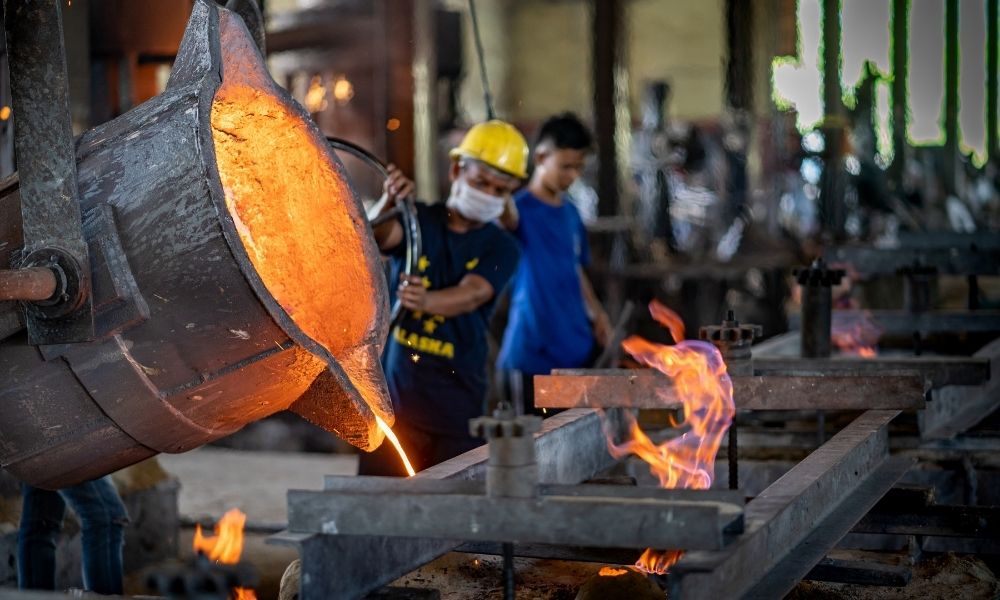
Various products can be made use of in Metal Casting processes, consisting of light weight aluminum, iron, bronze, and zinc. Each product provides distinct properties, affecting the spreading approach's efficiency, stamina, and suitability for different applications in production.
Exactly How Do Casting Methods Affect the Mechanical Qualities of Metals?
Casting methods considerably affect the mechanical homes of metals, influencing variables like toughness, ductility, and hardness. Variants in cooling down rates and mold materials can bring about different microstructures, eventually influencing the performance of the last product.What Are the Environmental Effects of Steel Casting Processes?
Metal Casting processes can bring about air and water pollution, resource deficiency, and considerable power consumption (Wisconsin Aluminum Foundry). Additionally, the generation of waste products and greenhouse gas exhausts substantially contributes and affects the atmosphere to environment modificationJust how Do You Select the Right Casting Method for a Project?
Selecting the ideal spreading approach entails evaluating job needs, material properties, complexity, and production volume. Factors like cost performance, finish high quality, and lead time also play important functions in identifying the most appropriate strategy.What Security Safety Measures Should Be Taken During Metal Casting Workflow?
Throughout Metal Casting procedures, safety and security precautions consist of wearing protective equipment, ensuring correct air flow, carrying out tools inspections, maintaining a tidy office, and having emergency procedures in location to take care of potential hazards like burns or toxic fumes.From the cost-effective sand casting approach to the precision of financial investment casting, each procedure has unique advantages. Pass away casting is an extremely efficient production procedure that succeeds in producing huge quantities of steel components with exceptional surface coatings. Lost foam casting changes the production of intricate steel parts by utilizing an unique procedure that eliminates the need for typical mold and mildews (Aluminum Foundry). Long-term mold casting is a highly efficient technique for creating long lasting and regular steel components, leveraging reusable molds that are generally made from metals such as iron or steel. Various products can be made use of in Metal Casting processes, including aluminum, bronze, iron, and zinc
Report this wiki page